CPE vs ODU vs MiFi: Choosing the Right Form Factor for Rural and Urban Connectivity
Not all 4G and 5G users have the same connectivity requirements.
A family in an urban apartment, a household in a rural area and a field worker traveling between locations may all need wireless internet access.
But they may need completely different devices.
For ISPs, distributors and router brands, choosing the right form factor is just as important as selecting the right chipset or network technology.
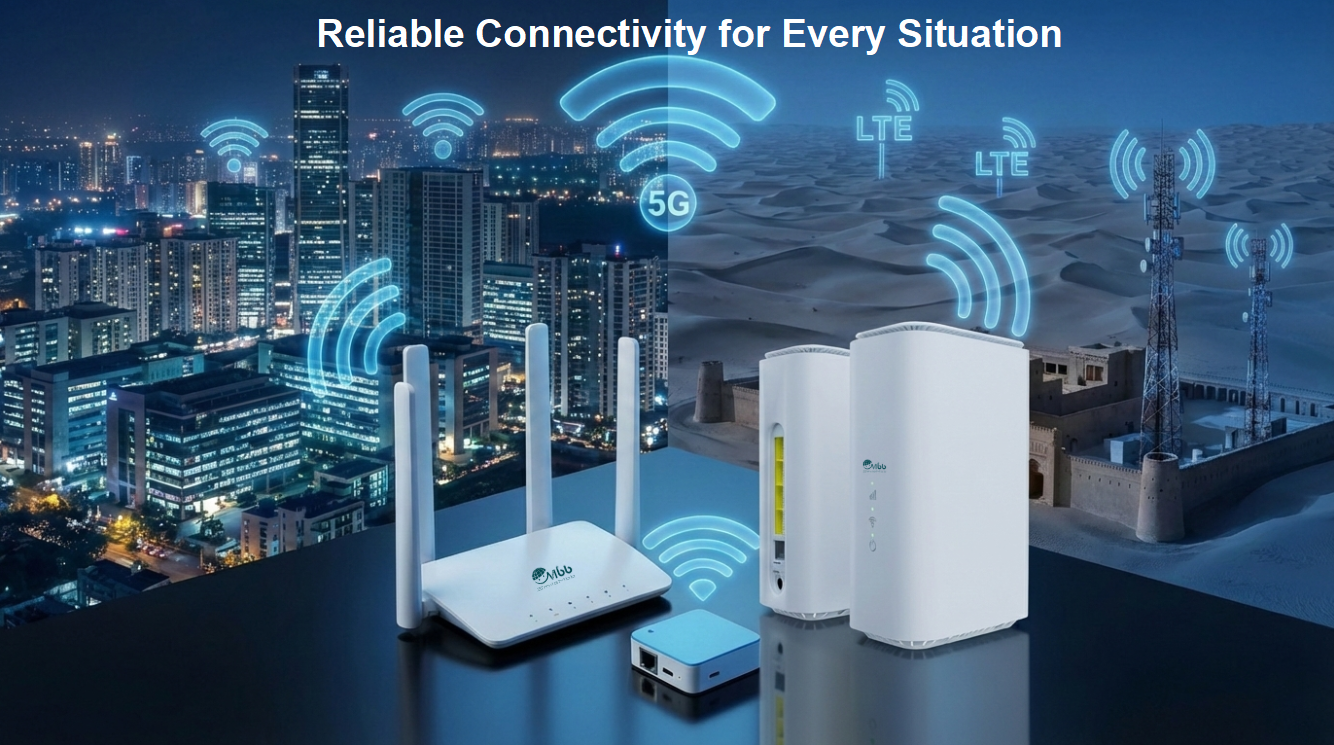
Let's compare three common options: CPE, ODU and MiFi.
1. What Is a CPE?
CPE stands for Customer Premises Equipment.
In the 4G/5G router market, an indoor CPE typically receives a cellular signal through an internal or external antenna system and distributes internet access through Wi-Fi and Ethernet.
Key characteristics:
-
Designed for fixed indoor use
-
Built-in Wi-Fi connectivity
-
Usually supports Ethernet connections
-
Can support multiple connected users
-
Easy to install without complex outdoor mounting
Typical applications:
-
Homes and apartments
-
Small offices
-
Retail stores
-
Temporary business locations
-
Urban FWA deployments
For urban users with reasonable cellular signal coverage, indoor CPE is often a convenient and cost-effective solution.
2. What Is an ODU?
ODU stands for Outdoor Unit.
In fixed wireless deployments, an ODU is installed outside a building, usually on a wall, roof or pole.
It is designed to receive cellular signals directly outdoors, where building materials are less likely to weaken the radio signal.
An ODU can be used as part of a two-box solution:
-
ODU: Handles the cellular connection outdoors.
-
IDU: Provides indoor networking, Wi-Fi and other functions.
Some ODU products also integrate routing and Wi-Fi capabilities, so the exact architecture depends on the product design.
Key characteristics:
-
Designed for outdoor installation
-
Often uses higher-gain directional antennas
-
Requires weather-resistant enclosure design
-
May use PoE or Ethernet for connectivity and power
-
Requires more installation consideration than indoor CPE
Typical applications:
-
Rural broadband
-
Remote homes
-
Locations with weak indoor cellular reception
-
Farms and industrial sites
-
Fixed wireless access deployments
For rural areas where indoor signal reception is poor, an outdoor ODU can provide a more reliable radio link.
However, performance still depends on antenna alignment, base station distance, interference, available spectrum and installation conditions.
3. What Is a MiFi?
MiFi is a portable wireless hotspot device that provides internet access through a mobile network.
Unlike fixed CPE and ODU products, MiFi is designed for mobility.
Most traditional MiFi devices include a rechargeable battery and built-in Wi-Fi.
Key characteristics:
-
Compact and lightweight
-
Portable design
-
Rechargeable battery
-
Built-in Wi-Fi hotspot
-
Suitable for a limited number of connected devices
Typical applications:
-
Business travel
-
Tourism
-
Field workers
-
Students
-
Temporary internet access
-
Backup connectivity
For users who need internet access in different locations, MiFi offers flexibility that fixed routers cannot provide.
4. CPE vs ODU vs MiFi: Key Differences
| Parameter | Indoor CPE | Outdoor ODU | MiFi |
|---|---|---|---|
| Main purpose | Fixed indoor broadband | Outdoor fixed wireless access | Portable internet |
| Installation | Plug and play | Outdoor mounting | Portable |
| Antenna | Internal or external | Often directional, higher gain | Compact internal |
| Power | AC adapter | PoE or dedicated power | Battery |
| Wi-Fi | Usually built-in | Depends on architecture | Built-in |
| Ethernet | Common | Depends on design | Limited or unavailable |
| Mobility | Low | Very low | High |
| Best suited for | Homes and offices | Weak indoor signal areas | Travel and mobile use |
Note: These are typical product configurations. Actual specifications vary by manufacturer and product architecture.
5. Which Form Factor Is Better for Urban Areas?
Urban environments usually have denser cellular infrastructure and more accessible network coverage.
For many urban applications, indoor CPE is a practical choice.
Why?
Easy installation
Users can place the device indoors and connect their phones, laptops, TVs and other equipment.
Flexible networking
Ethernet ports and Wi-Fi allow users to connect different devices without additional networking equipment.
Lower installation complexity
Compared with outdoor installations, indoor CPE generally requires less installation work.
For apartments, small businesses and urban households, an indoor 4G/5G CPE can provide a convenient broadband solution.
However, high-rise buildings, reinforced concrete walls and indoor dead zones can still create reception problems.
6. Which Form Factor Is Better for Rural Areas?
Rural deployments often face different challenges.
These may include:
-
Greater distance from base stations
-
Limited network infrastructure
-
Weak indoor signal reception
-
Difficult terrain
-
Lower population density
In these situations, outdoor ODU can be a valuable option.
By installing the device outside and using an appropriately designed antenna, the network connection may benefit from reduced building attenuation and improved signal quality.
An outdoor installation can be especially useful for mid-band 5G deployments, where building penetration and installation position can significantly affect performance.
However, an ODU is not automatically the best choice for every rural location. Actual signal conditions and installation costs should be evaluated first.
7. What Should ISPs and Router Brands Consider Before Choosing?
Before selecting a device for a new market, consider these five factors.
1. Network coverage
Check local operator bands, signal strength and available network technologies.
2. Installation environment
Will the device be installed indoors, outdoors or used while traveling?
3. Antenna requirements
Does the application need omnidirectional antennas or higher-gain directional antennas?
4. Power requirements
Is AC power readily available, or is battery operation necessary?
5. Total deployment cost
Consider not only the device price but also installation, maintenance, accessories and after-sales support.
The right solution should balance network performance, installation complexity and overall cost.
8. Final Thoughts
CPE, ODU and MiFi are designed for different connectivity scenarios.
-
Indoor CPE: A practical choice for fixed home and business broadband.
-
Outdoor ODU: A useful option for challenging signal environments and rural FWA.
-
MiFi: A flexible solution for portable internet access.
There is no single form factor that fits every market.
For ISPs, distributors and router brands, understanding the target user's environment is the first step toward selecting the right product.
At SmileMBB, we develop 4G/5G CPE and portable MiFi solutions, with OEM/ODM support for customized hardware, industrial design, firmware and packaging.
Looking for a suitable 4G/5G device for your market? Let's discuss your application and product requirements.