FDD vs TDD in 5G: Key Differences, Use Cases, and How to Choose the Right 5G Router
When choosing a 4G or 5G router, network compatibility is more than just checking the modem category or maximum download speed.
One important factor is duplex mode: FDD or TDD.
FDD (Frequency Division Duplex) and TDD (Time Division Duplex) are two fundamental methods used to separate uplink and downlink traffic in cellular networks. Both are widely used in 4G and 5G, but they serve different purposes and are commonly deployed on different spectrum bands.
So, what is the difference between FDD and TDD? Why is TDD so important in 5G? And what does it mean when selecting a 5G CPE or 4G/5G router?
Let's take a closer look.
1. What Is FDD?FDD stands for Frequency Division Duplex.
FDD uses two separate frequency ranges: one for uplink and another for downlink. Both directions can transmit simultaneously.
A simple way to understand FDD is to imagine a highway with two dedicated lanes:
-
One lane is used for uplink.
-
The other lane is used for downlink.
-
Both can operate at the same time.
Key Advantages of FDD
1. Wide-area coverage
FDD is widely used on lower-frequency spectrum, which generally provides better propagation and indoor coverage. This makes it suitable for broad geographic coverage.
2. Stable two-way transmission
Because uplink and downlink operate simultaneously on separate frequencies, FDD provides consistent communication for services with relatively balanced traffic requirements.
3. Strong 4G ecosystem
FDD has been widely deployed in LTE networks worldwide, making it an important technology for 4G routers, CPEs and mobile broadband devices.
Typical FDD Applications
FDD is commonly used for:
-
Wide-area 4G/5G coverage
-
Rural and suburban connectivity
-
Mobile broadband
-
Voice services
-
IoT connectivity
-
Backup Internet
-
4G LTE routers and CPEs
2. What Is TDD?
TDD stands for Time Division Duplex.
Unlike FDD, TDD uses the same frequency range for uplink and downlink. Instead of separating them by frequency, the network separates them by time.
Think of it as a single road controlled by traffic lights:
-
One time period is used for downlink.
-
Another time period is used for uplink.
-
The network controls how much time is allocated to each direction.
Key Advantages of TDD
1. Efficient spectrum utilization
TDD does not require paired spectrum. This makes it particularly attractive for operators using large blocks of unpaired spectrum.
2. Flexible uplink/downlink allocation
Modern Internet traffic is often asymmetric, with significantly more data being downloaded than uploaded.
TDD can allocate more transmission time to downlink traffic when needed.
3. Strong fit with 5G technologies
TDD works particularly well with technologies such as:
-
Massive MIMO
-
Beamforming
-
Large channel bandwidth
-
High-capacity 5G networks
This makes TDD especially important for 5G mid-band deployments.
3. FDD vs TDD: What Is the Difference?
The fundamental difference is simple:
FDD separates uplink and downlink by frequency, while TDD separates them by time.
| Feature | FDD | TDD |
|---|---|---|
| Full Name | Frequency Division Duplex | Time Division Duplex |
| Uplink/Downlink | Different frequencies | Same frequency |
| Transmission | Simultaneous | Time-shared |
| Spectrum | Paired spectrum | Unpaired spectrum |
| Traffic Ratio | Relatively fixed | More flexible |
| Coverage | Strong, especially on lower bands | Often used for capacity-oriented bands |
| Typical Use | Wide-area coverage | High-capacity networks |
| 4G/5G Role | Important | Major 5G capacity layer |
| Typical CPE Use | LTE / 5G broadband | High-speed 5G broadband |
Neither technology is universally "better."
The right choice depends on the spectrum, network architecture, coverage requirements and target application.
4. Why Is TDD So Important in 5G?
One of the biggest changes from 4G to 5G is the increasing use of mid-band spectrum for high-capacity mobile broadband.
Many 5G networks use TDD spectrum to provide larger bandwidth and higher network capacity.
TDD + Massive MIMO
5G networks increasingly use Massive MIMO and beamforming to serve more users and improve spectral efficiency.
TDD is particularly suitable for these technologies because the network can use channel information from the uplink to help estimate downlink channel conditions.
This allows the base station to make better use of large antenna arrays and beamforming.
TDD + Large Bandwidth
5G is designed to deliver significantly higher capacity than previous generations.
TDD spectrum can provide large blocks of continuous bandwidth, making it well suited for high-speed applications such as:
-
Fixed Wireless Access (FWA)
-
Home broadband
-
Business broadband
-
Video streaming
-
Cloud applications
-
High-speed mobile connectivity
TDD + Asymmetric Traffic
Most consumer Internet traffic is download-heavy.
For example, users typically download much more data when watching video, browsing websites or using cloud services than they upload.
TDD allows networks to allocate time resources according to traffic requirements, making it a natural fit for these applications.
5. Does TDD Replace FDD in 5G?
No.
This is an important point.
TDD has become a major technology for 5G capacity, but FDD remains essential for network coverage.
In real-world commercial networks, operators often combine different spectrum bands and duplex technologies.
A typical strategy is:
FDD → coverage and network foundation
TDD → capacity and high-speed performance
This combination allows operators to balance coverage, capacity and user experience.
For example, a lower-frequency FDD band can provide broad coverage, while a higher-capacity TDD band can deliver faster data rates in areas with high traffic demand.
So instead of asking "FDD or TDD?", it is often more useful to ask:
"Which FDD and TDD bands does the target market use?"
6. What Does FDD vs TDD Mean for 4G/5G Routers?
For a 4G or 5G router manufacturer, FDD and TDD compatibility is an important consideration.
A router may support excellent theoretical speeds, but if its supported LTE or 5G bands do not match the operator's network, its real-world value is limited.
When evaluating a cellular CPE, customers should consider:
1. Supported Frequency Bands
Check whether the router supports the major FDD and TDD bands used by the target operators.
This is especially important for international markets because spectrum allocation differs between countries.
2. Network Coverage
For rural or wide-area deployments, FDD low-band support can be particularly valuable.
3. Capacity Requirements
For high-density or high-traffic applications, TDD 5G support can help the router take advantage of high-capacity 5G networks.
4. Target Application
Different products may be designed for different scenarios:
-
Portable connectivity: compact 4G/5G MiFi or mini CPE
-
Home broadband: 4G/5G CPE
-
FWA: high-performance 5G router
-
Backup Internet: 4G/5G cellular router
-
Business connectivity: multi-port cellular CPE
Therefore, band support and network compatibility should be considered together with speed, Wi-Fi capability, Ethernet ports and product form factor.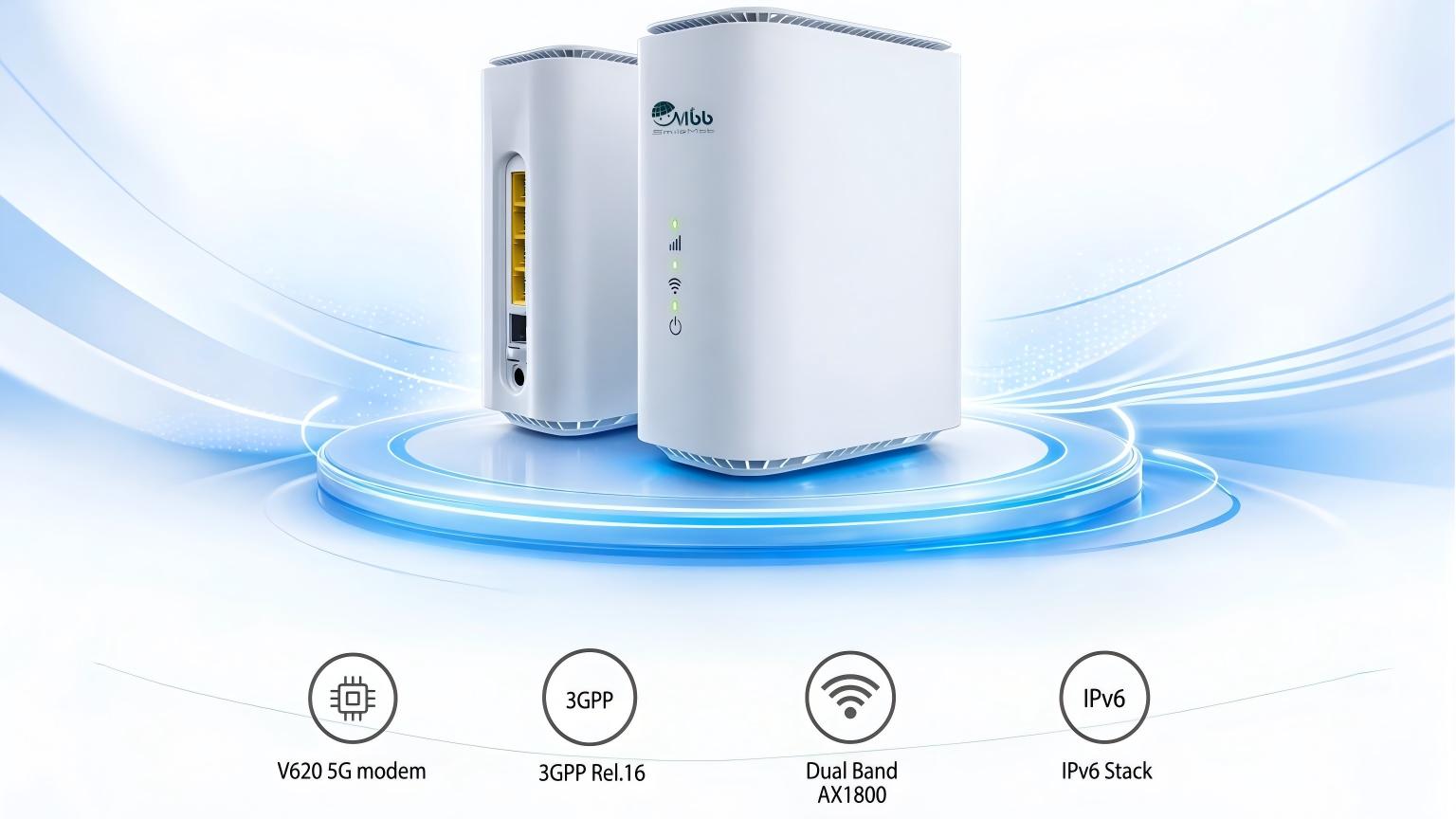
7. How to Choose the Right 4G/5G CPE?
For distributors, ISPs, operators and brand owners, choosing a cellular CPE is not simply about selecting the highest-speed chipset.
A practical evaluation should include:
Network compatibility
Does the device support the required FDD and TDD bands?
Cellular performance
Is 4G LTE, 5G NSA or 5G SA required?
Wi-Fi performance
Does the product need Wi-Fi 4, Wi-Fi 5 or Wi-Fi 6?
Ethernet connectivity
Is one LAN port enough, or are multiple Gigabit Ethernet ports required?
Product positioning
Is the target market looking for an affordable entry-level router or a higher-performance 5G CPE?
Deployment scenario
Is the device intended for home broadband, FWA, backup connectivity, portable Internet or another application?
A good CPE should match the network and business requirements, rather than simply maximizing specifications.
8. FDD and TDD in SmileMbb 4G/5G CPE Solutions
At SmileMbb, we develop 4G and 5G consumer-grade CPE solutions for different market and network requirements.
Our product portfolio covers compact 4G mini CPEs, 4G LTE routers and high-performance 5G CPEs.
For example, XMC1842 is a compact 4G Cat 4 mini CPE designed for portable and flexible connectivity. Its small form factor and USB Type-C power input make it suitable for applications such as temporary Internet access, backup connectivity and portable broadband.
For customers looking for higher-performance 5G connectivity, XMC6251 provides a 5G CPE platform with Wi-Fi 6 and multiple Gigabit Ethernet ports, making it suitable for home broadband and high-speed FWA applications.
The right solution depends on the target operator, frequency bands, market requirements and application scenario.
Conclusion
FDD and TDD are not competing technologies that one must completely replace the other.
FDD separates uplink and downlink by frequency, making it well suited to wide-area coverage and stable connectivity.
TDD uses the same frequency at different times, making it highly suitable for large bandwidth, flexible traffic allocation and high-capacity 5G networks.
In modern 5G deployments, the two technologies often work together:
FDD provides coverage. TDD provides capacity.
For 4G/5G router and CPE selection, understanding the FDD and TDD bands used in the target market is therefore just as important as looking at the advertised network speed.
The best cellular CPE is not necessarily the one with the highest specification — it is the one that matches the network, application and market.